


Phone:
+86-15218865186



|


The YK6030 oven motor is designed for high temperature environments and adopts a double ball bearing structure. It has excellent high temperature resistance and long life. It is suitable for home and commercial ovens, constant temperature equipment and other scenarios. The core components of the motor use H-class insulation materials, which can operate stably at high temperatures. With copper wire windings, it ensures high efficiency output and low energy consumption. It supports continuous load operation, comes standard with cooling fan blades, stable speed, and is widely suitable for various types of baking equipment.
1. High temperature resistant design
Using H-class insulation material, the temperature resistance reaches 180℃, with excellent thermal stability and electrical insulation, which can resist the risk of insulation layer aging and breakdown under high temperature conditions. The double ball bearing structure is specially hardened and manufactured with high precision, and has strong wear resistance.
2. High efficiency and energy saving
The high-purity oxygen-free copper wire winding has excellent conductivity and low resistance loss, which improves the energy efficiency of the motor by more than 20% compared with the ordinary aluminum wire winding. At a low power of 56W, it can stably output a precise speed of 2530±100r/min, taking into account efficient operation and energy saving, significantly reducing operating costs, and is suitable for small baking equipment, creating high value with low energy consumption.
3. Stable and reliable
Supports AC220-240V wide voltage input, can adapt to voltage fluctuations, operate stably in unstable power grid areas, and reduce failures. Adopts unidirectional clockwise (CW) rotation design, adapted to the oven structure, stable transmission without jamming. After harsh environment and aging tests, it can operate reliably in high temperature and humidity to ensure continuous operation of the equipment.
4. Low-noise operation
Using precision bearing manufacturing technology and high-precision dynamic balancing technology, the motor operation noise is reduced from both structural design and manufacturing technology. Through precision grinding of bearing balls and raceways, the dynamic balance of the rotor and stator is accurately corrected, greatly reducing friction and vibration. Actual measurements show that the noise is ≤45 decibels when running at full load, which is suitable for commercial baking places and home kitchens, creating a quiet use environment.
5. Easy to maintain
The standardized interface design makes connection and disassembly easy. Ordinary maintenance personnel can quickly replace the motor without professional tools and skills, which greatly shortens the maintenance time and reduces the frequency and duration of equipment downtime. With perfect after-sales support and sufficient spare parts supply, it guarantees equipment maintenance in all aspects, effectively reduces costs, reduces production interruption losses, and significantly improves equipment efficiency and economic benefits.
Product name |
Oven/thermostat motor |
Model |
YK6030 |
Wire |
Coppwe wire |
Bearing |
Ball bearing |
Voltage |
AC220-240V/50Hz |
Power |
56W |
RPM |
2530±100r/min(Load test with fan blades) |
Insulation class |
Class H |
Rotation direction |
CW |

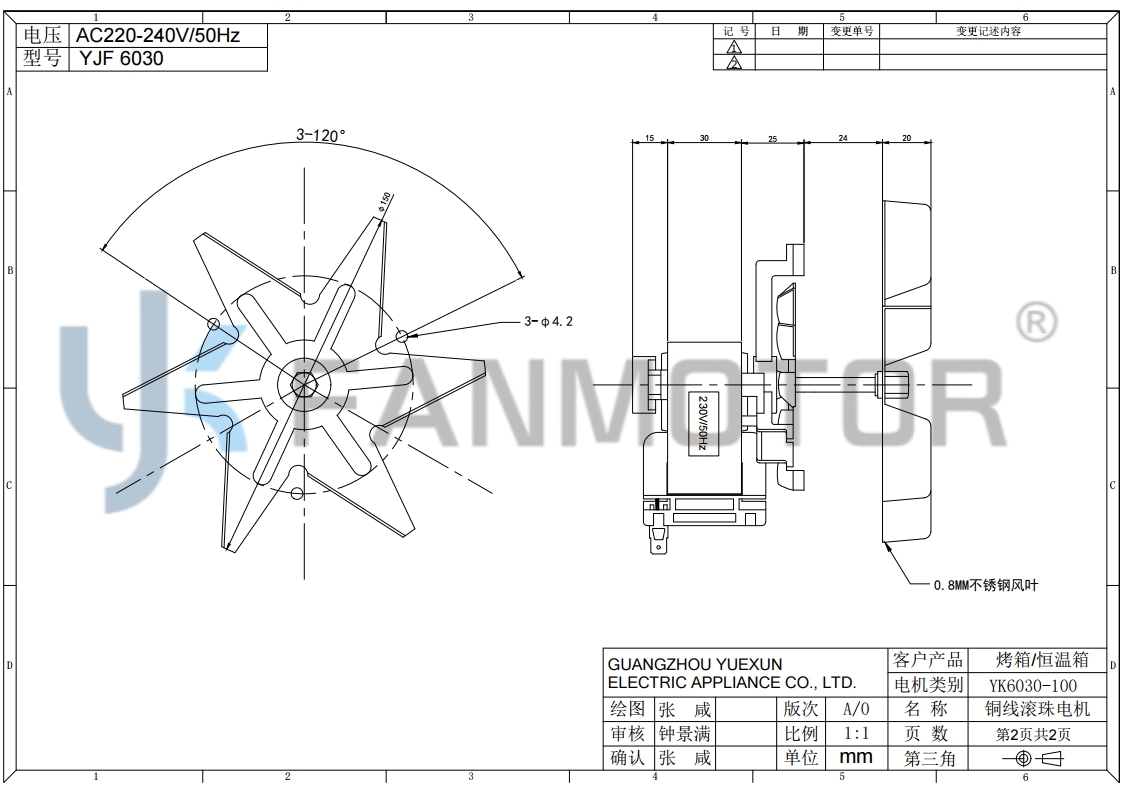
The 6030 double-ball high-temperature oven motor has the characteristics of H-class insulation (180°C), double-ball wear resistance, copper wire energy saving, wide voltage compatibility, etc. It achieves low-noise operation through precision technology, and the standardized interface is easy to maintain. It can be adapted to electric ovens, steam-bake all-in-one machines and other equipment to ensure stable temperature control and effectively reduce energy consumption, noise and maintenance costs.
 |
 |
 |
 |
 |
 |


| 206,207,208, No. 4, Lijun Road, Xili Industrial Zone, Shatou Street, Guangzhou, Guangdong, China |